Lifetime vs Rubbermaid Sheds: Buy Lifetime (Mostly)
Buy Lifetime for any real shed (8x10 up) — steel-reinforced HDPE walls, doors and trusses. Rubbermaid wins for small, fast, snap-together storage.
Resin sheds won the backyard storage war for a reason: no rot, no termites, no painting, no rusted-out panels — all of which matter double in California sun. The two names everyone cross-shops are Lifetime and Rubbermaid, and they're not really fighting over the same buyer. Lifetime builds steel-reinforced HDPE sheds that behave like small buildings; Rubbermaid builds snap-together resin storage that goes up in an afternoon. We've assembled plenty of both. Here's the verdict-first breakdown so you buy the right one for what you're actually storing.
Quick Comparison
| Pick | Best For | Approx Price |
|---|---|---|
| Best Overall (Real Shed) | Lifetime 8' x 10' Outdoor Storage Shed (Dual-Wall HDPE) | $1,100-$1,600 |
| Best Quick Storage | Rubbermaid Big Max 7' x 7' Storage Shed | $700-$1,100 |
| Best Big Footprint | Lifetime 11' x 11' Outdoor Storage Shed (Wide Doors) | $2,000-$2,900 |
Our Picks
Measure before you buy
Most returns on items like these come down to fit, and a returned item costs you a week and a trip. Four numbers settle it:
- Footprint: the listed size is usually the roof or nominal size. Measure the pad for the actual base dimensions plus 2 to 3 feet of working room on every side.
- Height: compare the peak height with fence lines, eaves and overhead branches, and check how far the doors swing.
- Base: resin and metal sheds need a level, square base (gravel, pavers or a frame). An out-of-level base is the number one reason panels will not line up.
- Rules: many California cities exempt one-storey accessory structures under 120 square feet from a permit, but setbacks and HOA rules still apply. Check with your city before the shed ships.
The 30-Second Verdict
Buy Lifetime for anything you'd call a real shed — 8x10 and up, garage overflow, a mower plus bikes plus shelving, anything you want standing straight in ten years. The dual-wall HDPE panels are steel-reinforced at the trusses and doors, the roof takes real weather, and the walls accept shelving and tool corrals. It costs more and the assembly is a genuine half-day-plus project.
Buy Rubbermaid when the mission is smaller and speed matters: trash-can enclosures, pool gear, a push mower and hand tools. The Big Max line snap-fits together in 1-3 hours with almost no fasteners, resists dents and sun fine, and costs hundreds less. It's just not trying to be a building.
The line between them is roughly 7 feet: under a 7x7 footprint, Rubbermaid's simplicity wins. At 8x10 and beyond, Lifetime is the only one of the two seriously playing — and the one we'd put our own gear in.
Construction: Steel-Reinforced HDPE vs Snap-Together Resin
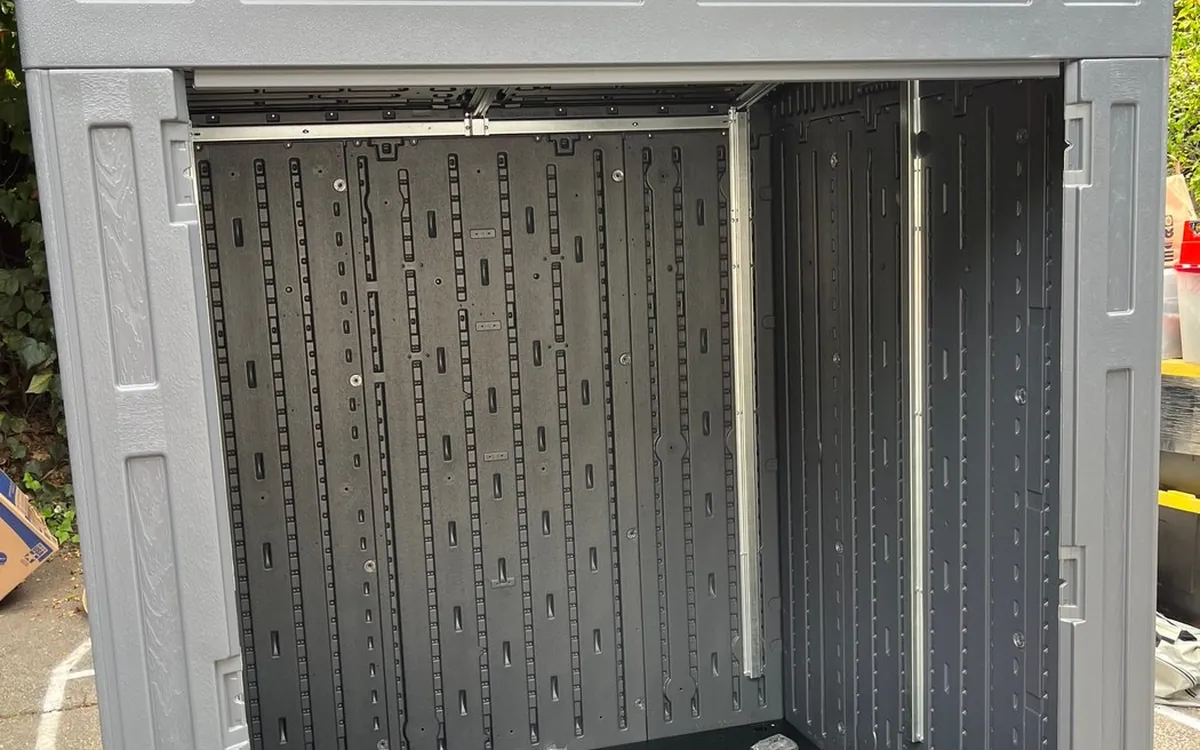
Lifetime builds with dual-wall high-density polyethylene panels — two skins with an air gap, stiffer and more dent-resistant than single-wall resin — and then runs powder-coated steel reinforcement through the structure: A-frame roof trusses, wall channels, and steel-framed doors. Panels screw to the steel and to each other with real fasteners. That skeleton is why a Lifetime shed shrugs off a leaning bike pile, a wind gust, or a shelf full of paint cans, and why the tall models don't oil-can in the sun.
Rubbermaid (the Big Max and Roughneck lines) uses thick blow-molded resin panels that interlock and snap together with minimal hardware. The panels themselves are tough — impact-resistant, UV-stabilized, easy to hose out — but there's little to no steel in the structure, so the shed's rigidity is all geometry. That's fine at 5x6 or 7x7 scale. It's also why Rubbermaid doesn't chase the 10-foot-plus footprints: snap-fit resin doesn't scale to building-sized spans.
Both materials laugh at termites, rot, and rust — the whole point of resin. The difference is that one is a paneled box and the other is a framed structure.
Size Lineups and What Actually Fits
Rubbermaid tops out small: vertical lockers around 2x2.5 ft for long-handle tools, mid-range 5x6-class sheds, and the flagship Big Max around 7x7 ft with a double door. A 7x7 swallows a push mower, two bikes, trash bins, and wall-hung hand tools — genuinely useful, but a riding mower or a workbench is not happening.
Lifetime starts where Rubbermaid stops: common footprints are 8x10, 8x12.5, 8x15, 11x11, and 11x18.5, with 6-ft-plus wide double doors, included skylights, windows, and interior shelving on most models. An 8x10 (80 sq ft) holds a riding mower or a full garage-overflow load with room to walk in; an 11x11 is a small workshop.
Two sizing tips from our installs: measure your door swing and approach path — a riding mower needs the wide-door models and a straight run-in; and go one size up from what today's clutter needs, because every shed we've ever assembled was full within a year. The cost per square foot drops as the footprint grows, so the bump is usually cheap.
Assembly: Real Fasteners vs an Afternoon of Snapping
Rubbermaid is the easy day: 1-3 hours, mostly rubber-mallet persuasion as panels click into floor and roof channels, with a handful of screws at the doors and roof. One determined adult can do a Big Max solo; two makes it pleasant. The only way to ruin it is an unlevel base — snap-fit joints that don't line up won't seat, and people blame the shed.
Lifetime is a real build: plan on 4-8 hours for two people on an 8x10, longer on 11-wide models. You're screwing panels into steel channels in sequence, raising trusses, and driving a few hundred screws — a drill/driver with a light touch matters, because overdriven screws strip or crack resin. Set the clutch low. The steps aren't hard, but they're order-dependent: skip ahead and you'll be un-building. Wind is the enemy on build day; a loose 8-foot wall panel is a kite, so don't start the walls with an afternoon breeze coming.
Both brands are absolutely honest about one thing in the manual that buyers ignore: the base must be level within about an inch end to end. That's the difference between doors that glide and doors that scrape forever.
The Base and Anchoring — Where Resin Sheds Live or Die
Both brands include a structural resin floor, and both still need something flat and solid under it: a concrete pad, compacted gravel with edging, or a pressure-treated wood platform. Setting either shed on bare dirt or lawn guarantees settling, racked walls, and binding doors within a season — it's the #1 cause of 'my shed doors won't close' calls we get. Gravel is the value pick (drains well, easy to level); concrete is the forever pick.
Then anchor it. A resin shed is light for its size — a few hundred pounds empty with a lot of wall area — and California wind treats an un-anchored one as cargo. Both brands provide anchor points in the floor and recommend kits: on concrete, that's concrete screws or wedge anchors through the floor's anchor locations; on gravel or soil, auger-style earth anchors with cables or straps per the manual. It's a $30-$60, 30-minute job that keeps a $1,500 shed off the neighbor's fence during the first Santa Ana of the season.
Bonus of doing the base right: your warranty conversations go better. Both companies ask about the base and anchoring before covering wind or door complaints.
California Sun, Heat, and the Long Haul
Full California sun is the real durability test for resin, and both brands pass it better than the no-name imports: UV-stabilized HDPE that fades slowly instead of chalking and going brittle. Two honest observations from sheds we've serviced years later. First, dark roofs bake — interior temps in a closed resin shed in the Valley easily pass 120°F in summer, so don't store anything heat-sensitive, and Lifetime's included skylights and screened vents earn their keep moving air. Second, long unsupported panel runs get wavy in heat on any resin shed; Lifetime's steel trusses and wall channels are exactly what prevents that on the bigger footprints, and it's the visible difference between a five-year-old Lifetime and a five-year-old bargain shed.
Warranty follows the same story: Lifetime backs its sheds with a 10-year limited warranty, Rubbermaid with a shorter limited warranty on its storage products. Neither covers wind damage on an un-anchored unit — see the section above.
Maintenance on either: hose it off, re-check anchor tension yearly, and keep sprinklers off the doors so hard-water spotting doesn't etch the panels. That's the whole list. It's why resin won.
Price, Permits, and Which One to Buy
Street pricing in 2026: Rubbermaid verticals and 5x6-class sheds run $350-$800, the Big Max 7x7 lands around $700-$1,100. Lifetime's 8x10 runs $1,100-$1,600, the 11x11 about $2,000-$2,900, and the long 11x18.5 past $3,500. Add $150-$400 for a proper gravel or pad base if you don't have one, plus the anchor kit.
Permit note for California: the 120 sq ft detached-structure exemption most cities honor covers every Rubbermaid and the Lifetime 8x10 (80 sq ft) and 8x12.5 (100 sq ft) easily — but an 11x11 is 121 sq ft, a single square foot over the usual line, and the 11x18.5 is far past it. Check with your building department before buying an 11-wide, and mind setbacks (commonly 3-5 ft from property lines) and HOA rules either way.
Final call: storing a household's worth of gear, buy the Lifetime 8x10 — it's the best structure-per-dollar in resin. Corralling bins and a mower, buy the Big Max and enjoy the easy afternoon. And if the half-day of truss-raising isn't your idea of a weekend, we assemble, level, and anchor both brands across California.
Need help with this in California?
Zomg The Handyman provides professional garage storage & organization across all of California. Upfront prices, 4.9★ rated. Same-day available.
Get a Garage Org Quote →Frequently Asked Questions
Are Lifetime or Rubbermaid sheds better?
Lifetime for any real shed (8x10 and up) — steel-reinforced HDPE walls, trusses, and doors make it a framed structure. Rubbermaid wins for small, fast, snap-together storage up to about 7x7.
How long does a Lifetime shed take to assemble?
4-8 hours for two people on an 8x10, longer on 11-wide models. It's a sequenced, screw-together build — set your drill clutch light so you don't strip the resin, and don't build in wind.
Do resin sheds need a foundation?
Yes — a level concrete pad, compacted gravel base, or wood platform, level within about an inch. Both brands include a resin floor, but on bare dirt the shed settles, walls rack, and the doors bind.
Do Lifetime and Rubbermaid sheds need to be anchored?
In California, absolutely — resin sheds are light with big wall area, and un-anchored ones move in Santa Ana winds. Use concrete screws on a slab or auger-and-cable kits on gravel/soil at the floor's anchor points.
Will a resin shed survive full California sun?
Both brands use UV-stabilized resin that fades slowly rather than going brittle. Expect 120°F+ interiors in summer — don't store heat-sensitive items, and Lifetime's skylights and vents help move air.
Do I need a permit for a Lifetime shed in California?
The 8x10 (80 sq ft) and 8x12.5 (100 sq ft) usually fall under the 120 sq ft exemption most cities honor. The 11x11 is 121 sq ft — one foot over the usual line — so call your building department first.
What fits in a Rubbermaid Big Max?
A push mower, two bikes, trash bins, and wall-hung hand tools — about the ceiling for a 7x7 snap-together shed. A riding mower or workbench needs a Lifetime 8x10 or bigger with the wide doors.
Can you assemble a resin shed for me?
Yes — we level or build the base, assemble, and anchor Lifetime, Rubbermaid, and other resin sheds across California, usually in one visit, and haul away the mountain of packaging.
Recommended for Your Garage Storage & Organization Job
Get it installed